Unleashing AI's Full Symphony: Mastering Context in Distributed Apps to Amplify Developer Dreams
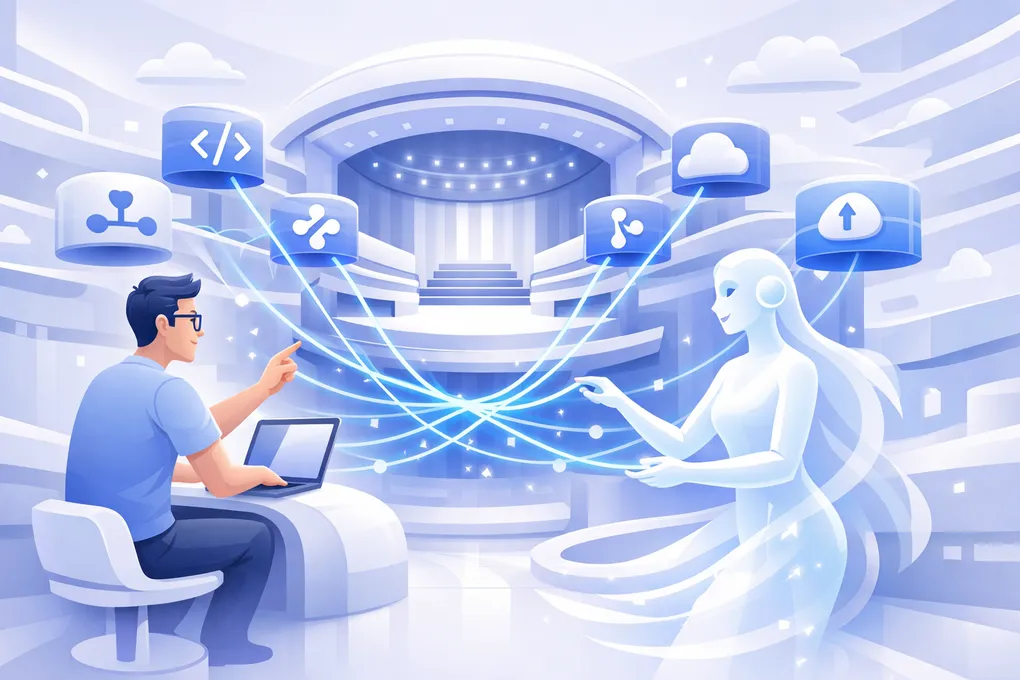
Unlocking the Power of AI Agents in Distributed Applications: A Tale of Context and Collaboration
Imagine building a grand castle, not with a single massive stone, but with thousands of intricate pieces—each crafted in isolation, yet destined to interlock in a symphony of strength and beauty. That’s the essence of distributed applications: a mosaic of interconnected services, repositories, and infrastructures that, when woven together, power the digital world. But in this intricate dance, humans and AI agents face strikingly different challenges. As developers, we thrive on piecing together the puzzle, one fragment at a time, until a vivid mental map emerges. For AI agents, however, the path is often a maze of silos, dimming their brilliance.
What if we could bridge this gap? What if we empowered agents to see the full castle, not just the bricks? In this article, we’ll journey through the human developer’s intuitive process, confront the agent’s contextual blind spots, and uncover strategies to unleash their full potential. By the end, you’ll be inspired to reimagine your workflows, blending human insight with machine magic to build faster, smarter, and with unshakeable confidence.
The Human Edge: Crafting Mental Models, One Piece at a Time
Distributed applications are masterpieces of modularity—separate repositories housing distinct services like infrastructure setups, databases, external APIs, and user-facing gateways. This separation isn’t a flaw; it’s a superpower for human developers. It allows us to dive deep into one “piece” at a time, mastering its nuances before stepping to the next.
Picture this: You open the infrastructure repo, unraveling its deployment scripts and cloud configurations. Confidence builds as you grasp its rhythms. Then, you pivot to the database layer, tracing data flows and schema designs. Gradually, you merge these insights in your mind, visualizing how they pulse together. It’s a deliberate, step-by-step odyssey—one that fosters speed and surety. By the time you’ve orchestrated the full ensemble, you’re not just coding; you’re conducting a symphony. This incremental context-building isn’t just efficient; it’s exhilarating, turning complex puzzles into triumphs that fuel our passion for creation.
The Agent’s Silent Struggle: Siloed Knowledge in a Connected World
Now, flip the script. Enter the AI agent—your tireless digital apprentice, eager to assist. You grant it access to one repository, and it eagerly constructs a detailed mental model: code structures, dependencies, and logic flows. Brilliant. But then comes the second repo. The agent rebuilds from scratch, siloed in isolation. No seamless merge, no shared “aha” moments like the ones sparking in your brain.
This fragmentation is the Achilles’ heel of agentic development. Agents excel when armed with holistic awareness—the “what,” “how,” and “why” of the entire application:
- What is the application? Its core purpose and user journeys.
- How is the infrastructure orchestrated? From provisioning to scaling.
- How does code brew in CI/CD pipelines? Automated builds, tests, and deploys.
- How do these distributed pieces harmonize? Cross-service interactions, error handling, and emergent behaviors.
Without this unified view, agents falter on cross-cutting concerns—security audits spanning services, performance bottlenecks hidden in integrations, or scalability tweaks rippling across the board. The result? Underutilized potential, where the agent’s speed is hobbled by incomplete sight. It’s a quiet tragedy: machines built for boundless intelligence, leashed by our fragmented tools.
Embracing the Monolith Mindset: Grouping for Greater Insight
But here’s the spark of hope: What if we treated our distributed empire like a temporary monolith? Not by smashing repos into one bloated codebase—that’s a relic of the past—but by logically grouping them on our local machines. Cluster them by domain (e.g., all user-facing services), by requirement (e.g., authentication stack), or even holistically (the full 20-repo beast).
Fire up your IDE and load the group as one expansive workspace. Suddenly, the agent isn’t nibbling at edges; it’s feasting on the feast. Navigation tools highlight connections, diffs reveal inter-repo ripples, and queries span the collective. This mirrors our human magic: distilling distributed chaos into a cohesive mental canvas.
The payoff? Agents interpret natural language instructions with surgical precision—“Optimize the image resizing service for low-latency CDN delivery”—drawing from the full tapestry to suggest holistic fixes. It’s not just efficiency; it’s empowerment, turning agents from helpful elves into visionary architects.
The Human Arsenal: Beyond Code, a World of Wisdom
Yet, even this grouping scratches the surface. Humans don’t just juggle repos; we wield a vast ecosystem of intel:
- Platform access: Dashboards for real-time monitoring, logs for debugging live flows.
- Rich narratives: User stories, requirement docs, and architecture diagrams that breathe life into specs.
- Cloud immersion: Hands-on environments revealing true integrations and runtime quirks.
- Deployment diaries: GitHub Actions or CI/CD pipelines chronicling how code evolves from commit to cloud.
These aren’t luxuries; they’re the lifeblood of inspired development. Agents, starved of them, operate in a vacuum—potent, but perilously narrow.
MCP Servers: A Step Forward, But Not the Horizon
Enter MCP (Multi-Context Provider) servers—a clever bridge, aggregating repo insights into a unified feed for agents. It’s a solid start, feeding the beast without constant repo-hopping. But pause and zoom out: Custom MCP setups demand extra engineering—another cognitive tax on already stretched teams. Worse, they tether the agent’s vast potential to human-conceived tools, capping creativity at our current imagination.
MCP is a ladder, not a launchpad. It hints at what’s possible but leaves us yearning for more.
Setting Agents Free: Tools, Access, and Human Guidance
So, what’s the bolder path? Unleash the agents. Equip them with the raw arsenal a developer commands, then step back as the architect and reviewer. Run them in your developer environment—your machine, your rules—infused with:
- Vendor CLIs: Pre-configured for seamless cloud interactions.
- Tokens and APIs: Programmatic keys unlocking platforms without friction.
- Helper scripts: Reusable utilities for common rituals, like pipeline simulations or log parses.
No overbuilt intermediaries. Just freedom: Let the agent roam your ecosystem, querying live environments, sifting docs, and tracing deploys. You provide the high-level vision—“Refactor for microservices resilience”—and iterate on their proposals. It’s a partnership of equals: Machines grind the details with superhuman speed; humans infuse soul, ethics, and foresight.
This isn’t delegation; it’s duet. You’ll learn from their patterns, refine your instincts, and maintain ironclad control—all while accelerating delivery to warp speed.
The Dawn of Synergistic Creation: Build Boldly, Together
In the end, distributed applications aren’t just code; they’re stories of connection—human ingenuity meeting machine might. By bridging contextual chasms, grouping wisely, and granting agents their wings, we don’t just solve problems; we transcend them. Teams deliver not faster, but better—innovative, resilient, alive with possibility.
So, developer, agent-whisperer: Take this challenge as your call to adventure. Group your repos. Arm your allies. Guide with grace. The castles you’ll build? They’ll stand taller, shine brighter, and inspire generations. What’s your first grouping? Your next instruction? The future is collaborative—seize it, and watch your world expand.